Chris Busby
Sep 29, 2026
Updated
Introduction
Glass-walled offices bring natural light and openness into a workspace, but they can also leave conference rooms, private offices, and client areas exposed.
Smart Film adds switchable privacy to suitable existing glass without replacing it. This guide explores its uses in Austin businesses and the installation details to plan.
Understanding Smart Window Film Technology
What Is Smart Window Film?
Smart Film is an advanced technology that transforms ordinary glass into switchable privacy glass with the flip of a switch or tap on a smartphone. Unlike traditional window films with a fixed appearance, standard PDLC Smart Film becomes transparent when powered on and frosted when powered off.
The technology uses polymer-dispersed liquid crystal (PDLC) film applied to suitable existing glass. When powered off, the liquid crystals scatter light, creating a frosted appearance. When powered on, the crystals align, allowing a clearer view through the glass.
Smart Film vs. Traditional Privacy Solutions
Feature | Smart Window Film | Traditional Film | Blinds/Curtains | Smart Glass |
Switchable Privacy | Yes | No | Manual | Yes |
Installation | Applied to existing glass | Applied to existing glass | Requires hardware | Requires replacing or specifying the glazing unit |
Maintenance | Minimal, no moving parts | Minimal | Regular cleaning, repairs | Minimal |
Professional Appearance | High-tech, sleek | Static appearance | Traditional | High-tech, sleek |
Cost | Moderate investment | Low investment | Moderate investment | High investment |
Control Integration | Digital/automated | None | Limited automation | Digital/automated |
Austin Business Applications for Smart Window Film
1. Professional Services Firms
Austin's growing legal, financial, and consulting sectors require confidential client meetings while projecting a modern image.
Key Applications:
Conference room privacy during sensitive meetings
Privacy for partners’ and executives’ offices
Client meeting spaces with on-demand confidentiality
Reception areas with branding potential
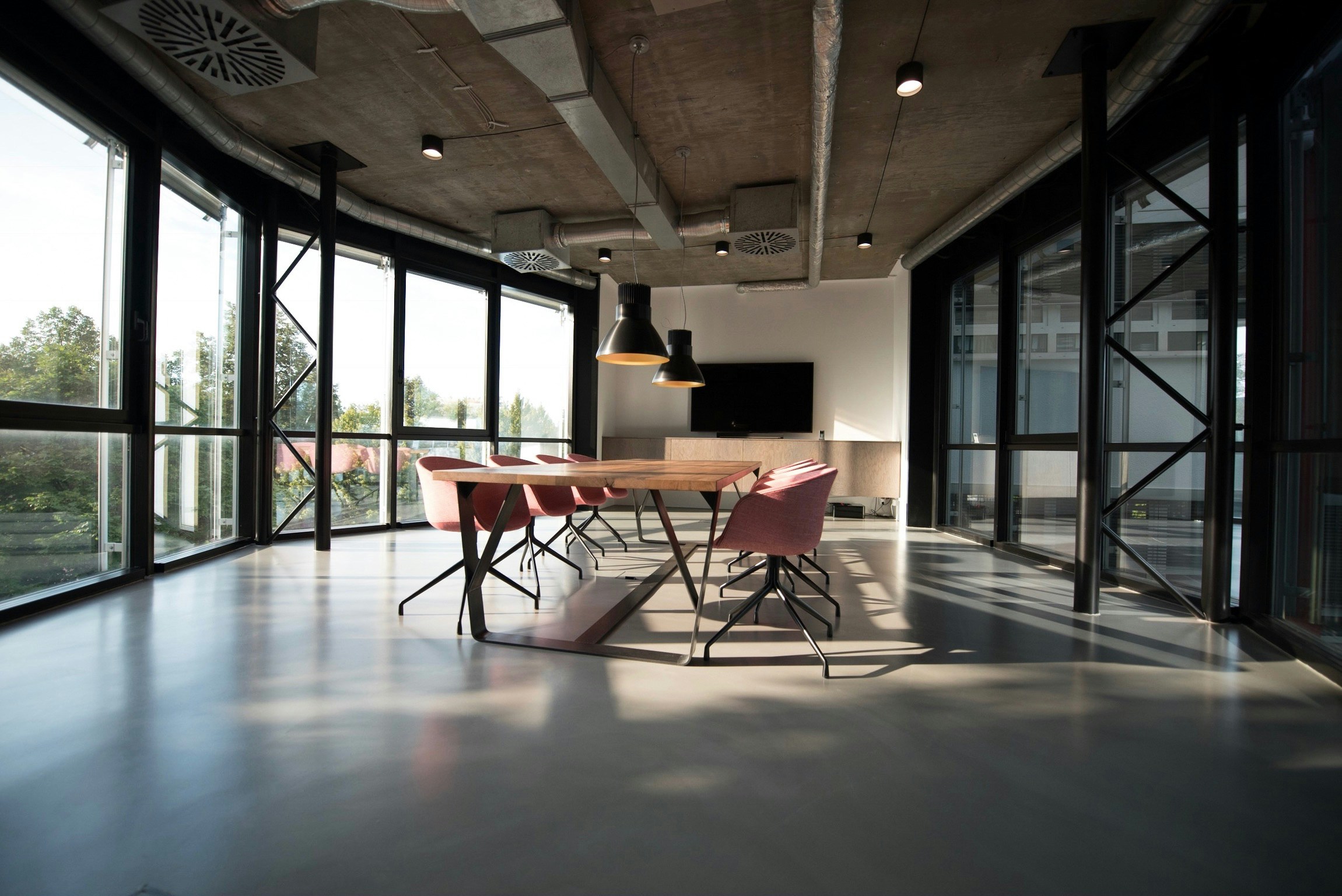
Example: Legal conference room. A glass-walled conference room could switch to a frosted state for meetings and return to a clear state afterward. Room-level confidentiality still requires operational controls.
Consider sightlines, entry doors, and how the controls will be used during meetings.
2. Technology Companies
Austin's booming tech sector, from established companies downtown to startups in East Austin, benefits from flexible workspace solutions.
Key Applications:
Agile meeting spaces with reconfigurable privacy
Shared workspaces with on-demand visual privacy
Demo rooms with controlled visibility
Creative spaces with glare control for screens
Example: Technology workspace. A glass-walled workspace could use switchable film to change visibility during confidential work.
Plan control zones and access for the people using the room.
3. Healthcare and Medical Offices
Austin's expanding healthcare sector prioritizes both patient privacy and modern, welcoming environments.
Key Applications:
Examination room privacy
Consultation spaces
Reception partitions
Staff workstations with adjustable privacy
Example: Medical office. A treatment room could use switchable film to limit visibility through interior glass when appropriate. Clinical privacy procedures still need separate review.
Switchable film is a visual privacy tool; its use alone does not establish regulatory compliance.
4. Hospitality and Restaurants
Austin's hospitality industry benefits from dynamic space management with Smart Film technology.
Key Applications:
Private dining areas with adjustable visibility
Event spaces with adjustable visibility through glass partitions
Hotel meeting rooms with flexible privacy
Bathroom partitions with enhanced privacy
Example: Hospitality space. An event venue could vary visibility through glass partitions as room use changes.
Film changes sightlines; it does not create a physical room divider.
Smart Film Installation Considerations for Austin Businesses
Glass and Site Conditions
Check the existing glass, coatings, access, and sun exposure before choosing film for an office or commercial space. Interior meeting-room partitions and exterior windows have different requirements; review the selected product for each location.
Austin Building Types and Challenges
Different Austin commercial buildings present unique installation considerations:
Downtown High-Rises (such as 100 Congress and Frost Tower):
Access requirements for upper-floor installations
Building management approval processes
After-hours installation scheduling
Existing window film removal (if applicable)
Historic Buildings (in areas such as Sixth Street and the Warehouse District):
Compatibility with historic glass
Power access challenges in older structures
Compliance with preservation requirements
Temperature fluctuation management
New Construction (developments in the Domain, Mueller, and East Austin):
Coordination with construction schedules
Integration with smart building systems
Architect and designer collaboration
Warranty coordination with building completion
Planning Privacy Controls for Staff
Plan control zones around how each room is used. A conference room, private office, and treatment area may need separate switches and different privacy routines.
Place controls where staff can reach them and agree on when privacy should be enabled. If the building already uses automation, discuss how the film should fit the existing workflow.
Implementation Process for Austin Businesses
1. Consultation and Assessment
On-site evaluation of glass surfaces
Privacy needs assessment
Control system planning
Integration with existing systems
2. Custom Solution Design
Film selection based on specific requirements
Control system design
Integration planning with existing technology
Cost-benefit analysis
3. Professional Installation
Minimal business disruption (often completed after hours)
Thoroughly tested electrical connections
Clean, precise application
Complete system testing
4. Staff Training and Support
User control training
Maintenance guidelines
Troubleshooting procedures
Ongoing support access
Austin-Specific Installation Partners
Rapid Glass ATX specializes in commercial installations for Austin businesses:
Local Austin expertise and coordination around building requirements
Established relationships with Austin property management companies
Custom solutions for Austin's unique architectural styles
Rapid response for Austin-area service needs
Choosing office privacy film around the work being done
A business privacy project starts with what people can see through the glass. Is a presentation readable from a public corridor? Can visitors see into a consultation room? Does an office need visual separation for focused work but openness the rest of the day? Answering those questions identifies the panes that matter and gives the installation a specific purpose.
For an Austin conference room, walk the corridor during a typical meeting and look toward screens, whiteboards, and seating. Consider the entrance as well as the fixed glass. A privacy setting is more useful when it covers the relevant sightline and staff can activate it before work begins. For additional product-planning detail, see our commercial Smart Film specification guide.
Switchable film versus fixed frosted office glass
Fixed frosted film can suit a room that should stay visually separated throughout the workday. Switchable privacy film suits a room whose use changes: an open meeting area in the morning, a private client discussion later, and a clear view when the room is empty. The distinction is control over visibility, rather than a claim that one product solves every workplace requirement.
Evaluate appearance from both sides of the partition. Put a sample near the actual glass and review it with room lights on, corridor lights on, and daylight entering nearby windows. Test a person and a screen at their expected distances from the treated surface. These observations are more useful than judging privacy from a photograph taken in another building.
Plan commercial installation without interrupting operations
List when the room can be taken out of service and whether staff, patients, or guests use adjoining areas. Ask the installer about preparation, equipment access, noise from related work, and the handover sequence. A small office and an occupied medical facility can require different schedules even when their glass areas are similar.
Assign someone to coordinate with property management and the installation team. Provide the pane schedule, building access instructions, and any finish restrictions before work is booked. Identify the approved controller location and a route that remains accessible for service. If the suite is leased, confirm who can approve changes to the glazing and surrounding finishes.
Staff controls and privacy routines
A wall control near the entrance may be more practical than a remote kept in a drawer. Separate rooms may need independent operation, while multiple panes in one conference room may work best together. Describe the intended behavior during a power interruption and when normal operation resumes. Confirm that behavior with the actual system rather than assuming it from a demonstration of another product.
Include operation in the room’s handover. Show staff how to switch the glass, identify the service contact, and explain the approved cleaning method. For a healthcare or professional-services setting, include visual privacy in existing procedures alongside access control, sound privacy, screen placement, and document handling.
Budget and next steps for an Austin business
Keep a room-by-room list of dimensions and priorities. Mark which partitions need changing privacy and which can remain clear or permanently frosted. Use the price calculator for an initial estimate and our cost guide to understand the difference between film material and the complete installation.
Bring photos and the working-room requirements to a Rapid Glass consultation. The goal is a system employees can use at the right moment: open glass when connection matters, visual separation when the work calls for it, and a defined plan for ongoing care.
Conclusion: The Future of Privacy Solutions for Austin Businesses
Smart Film gives Austin businesses a way to add visual privacy while keeping glass spaces flexible and open when needed.
Whether your business occupies a downtown high-rise, a renovated historic building, or a modern campus, the right film and controls should fit how your team uses the space.
Plan the glass compatibility, electrical work, and operating controls together for an installation that fits your privacy needs and design.
Interested in exploring Smart Film solutions for your Austin business? Contact Rapid Glass ATX for a consultation and a Smart Film demonstration.